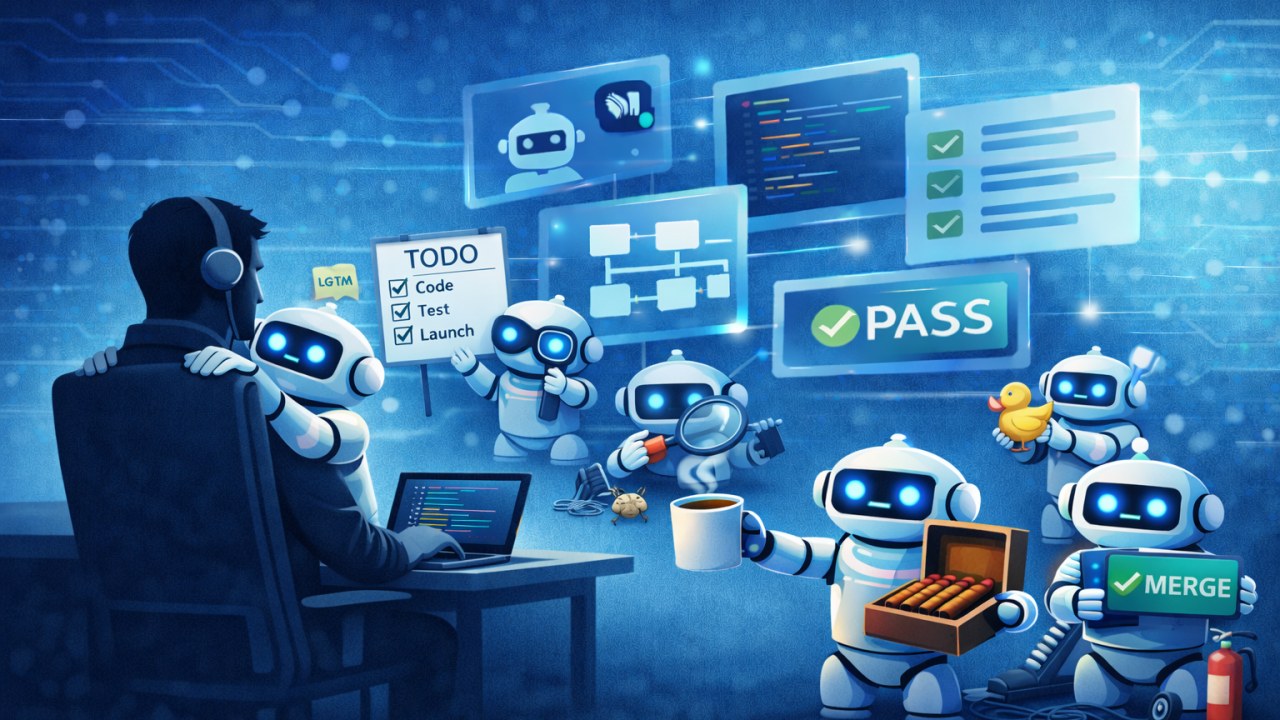
Over the last months, I’ve become increasingly interested in AI-assisted software development - and a little surprised by something else: in my circle, I still see quite a bit of reluctance to even try the tools that are already out there.
I get it. When I first heard about them, I was skeptical too. Like many of us, I’d played with earlier “AI for coding” and walked away thinking: Okay... it can generate a snippet, maybe write a commit message, and save me 3 seconds. Useful, but not exactly revolutionary. Then I tried the newer wave properly. And… wow.
I’ve been exploring tools like Cursor, Windsurf, Junie, Antigravity, Claude Code, Copilot, and others. What shocked me wasn’t “code generation” - it was the workflow. You give a clear specification, and the agent doesn’t just dump code and disappear. It builds the feature, writes tests, runs them, notices failures, investigates why, fixes the code, runs the tests again, and iterates until it works. Some tools go further: debugging, tracing runtime behavior, even reasoning about what’s happening on screen. At that point, it stops feeling like autocomplete and starts feeling like a new way of engineering.
What’s emerging around this is just as interesting as the tools themselves: patterns and processes that make the collaboration actually work. Define requirements first. Ask for codebase analysis. Get a detailed plan. Implement step by step, keep only relevant stuff in the context. Connect to external systems (MCP). Define reusable “agent skills”, perhaps with time, create a full repository of them. In this setup, the developer’s role shifts: you set the environment, frame the problem, steer decisions, review output, and keep quality high - while the agent handles a big chunk of the time-consuming execution. And while one agent is working, you can spin up another one to work on a different topic. That parallelism alone changes the pace.
The speed of progress here is wild. A year ago I attended a conference. One of the talks was about migrating a legacy Java application to a modern stack with ChatGPT. Multiple developers, multiple weeks - and everyone was amazed it was even possible. Thinking about what’s available today, I honestly believe a lot of that could be done dramatically faster now, perhaps within a day or days. That’s how quickly this space is moving.
So why this post? I normally don't post anything ;). Because I genuinely wonder where the reluctance comes from. I don’t think it’s denial, and I don’t buy the “AI is taking our jobs tomorrow” angle as the main reason (also: if an agent can take my job, I’d like it to at least fix the flaky tests first 😄). Maybe some people simply haven’t tried. Maybe they tried once, hit a wall, and decided it wasn’t for them. Or maybe my sample is biased.
One argument I’ve heard recently is that relying on these tools could slow down growth as a developer - that if you don’t struggle through everything alone, you won’t mature. I was surprised, because I had never considered this perspective. But I don’t agree. Like any powerful tool, it depends on how you use it. You can absolutely use it to coast... or you can use it to learn faster, explore alternatives, get feedback, and spend more time on the parts that actually make you better: architecture, reasoning, trade-offs, communication, and craftsmanship.
Even if your only goal is to find the limits, I strongly believe it’s worth jumping on this train. Try one or two tools. Use them on a small feature. Let them write tests. Let them refactor something annoying. See what clicks. Because this is starting to look like in future, it might become a big part of our profession - and ignoring it feels like the fastest way to become a dinosaur 🦖, sooner than anyone expects.
What’s been your experience so far: excited, skeptical, disappointed, amazed - or simply too busy to explore?